Mahad Diaries: Where History Meets Serenity (January 2025)

Exploring the Quiet Beauty of a Riverside Town

This January, we decided to start the year by exploring our very own Maharashtra. It’s funny how we often overlook the beauty of humble places right around us, instead chasing after glamorous tourist spots buzzing with people and packed with artificial charm. But this time, we chose a different path. On one of our earlier trips to Goa, we had passed through a quaint little town called Mahad. It caught our eye with its serene and picturesque charm, and we promised ourselves we’d come back someday. So, we thought, why not make it the first journey of the year
Dates: Jan 1 – Jan 4 2025
Day 1: Jan 1 2025
We started from Mumbai and our lovely picnic started. We had booked a quiet cottage named “River Land” near Mangaon. As usual with lots of food, maps downloaded and equipped with all sorts of gadgets and cameras we started. On our way we stopped at a cute little hotel “Balaji kitchen” at Karnala for breakfast. We reached Mahad at around 12:30 and to our delight the cottage we had booked was right at the bank of the river Savitri and was cosy and peaceful just as promised. We were lucky to get home like food at our resort.
On day 1 we decided to visit a temple which was known for its ‘veergal’. I have some interest in history and was very curious to see the veergals. I had seen them in pictures and was looking forward to seeing one in person. A quick about what a ‘veergal’ is. Its a memorial stone found in India, especially in places like Karnataka, Maharashtra, Tamil Nadu, Andhra Pradesh, and Gujarat. These stones were made long ago to honor brave warriors, soldiers, or people who gave their lives in battles or to protect their community. One of the veergal is called as ‘Ravan Veergal’ and after studying a little about Veergals we realised that Ravan Veergal is the only one of its type found in India which was located at temple Ambareshwar. This was the end of day 1 of our four day trip.
Day 2: Jan 2 2025
Our day started a little late. We lazed away, had breakfast at leisure and started from the hotel at around 10:30 AM. We had decided to cover 3 places and had to travel for a little over an hour to reach our first destination ‘Walan Kond’. Equipped with our map we crossed winding roads and scenic landscapes and reached the point that map took us to. Walan Kond was nowhere in sight. We met one Mr. Jagtap whom we asked for directions and came to know that many people mistakenly landed at this village Adrai which was wrongly marked as Walan Kond. Though mistakenly, we had landed at one of the most picturesque villages I had ever seen. With new directions now known, we travelled back to the real place we were looking for - the Walan Kond. The place was rocky with a temple situated right at the heart of the rocky land mass. We had to take a bridge to visit the temple. We’re not a religious lot and we explored the rocky surroundings more than the temple itself. The place had a very unique terrain.
Our second destination was Shivthar ghal. On our way we had lunch at a small village named Birwade. Shivthar Ghal is a place with deep religious significance, where Samarth Ramdas spent ten years writing Dasbodh. As you may know, Dasbodh is a spiritual book offering simple teachings on faith, self-improvement, and living a meaningful life. Visiting a place once inhabited by such great figures in history is an experience that's hard to put into words—awestruck? Inspired? Honestly, I was completely overwhelmed to realize that people like Samarth Ramdas achieved greatness by writing profound works like Dasbodh in such a harsh and unforgiving environment, like a cave. I found myself a bit let down though, by the way the cave has been reconstructed. In an effort to safeguard its heritage from damage, it’s now covered with a roof and a concrete facade. Sadly, this seems to have taken away the charm of the waterfall and the cave itself. Still it was a memorable experience.
Next, we visited the serene village of Padaji Cha Kond, the native place of our maid. If not for her, we would have missed this rustic gem. The village is a quaint, picturesque spot with a peaceful neighborhood, charming thatched-roof houses, and adorable little bridges, all nestled amidst mountains and greenery. With only a few inhabitants, the place had a unique charm. It made me reflect on the unnecessary stress and relentless competition of city life, sparking the thought: would the world be better if we limited our desires and stayed closer to nature? Of course, it's just a passing thought, soon forgotten as you go back home and get immersed into our daily lives.
One thing I must mention is the name ghotala we were faced with. Our two-day trip turned into a hilarious geography lesson! Who had known that one place could have so many names and that one name could be given to so many places all in such close vicinity! It was like One Hundred Years of Solitude had come to life, where names repeat endlessly, as if creativity had gone on strike. We stumbled upon not one, not two, but three Dahiwalis—each with its own twist, like Dahiwali Kond and Dahiwali Budruk. By the end, we were laughing so hard, we couldn’t tell if we were dizzy from the names or the journey! 😂
Day 3: Jan 3 2025
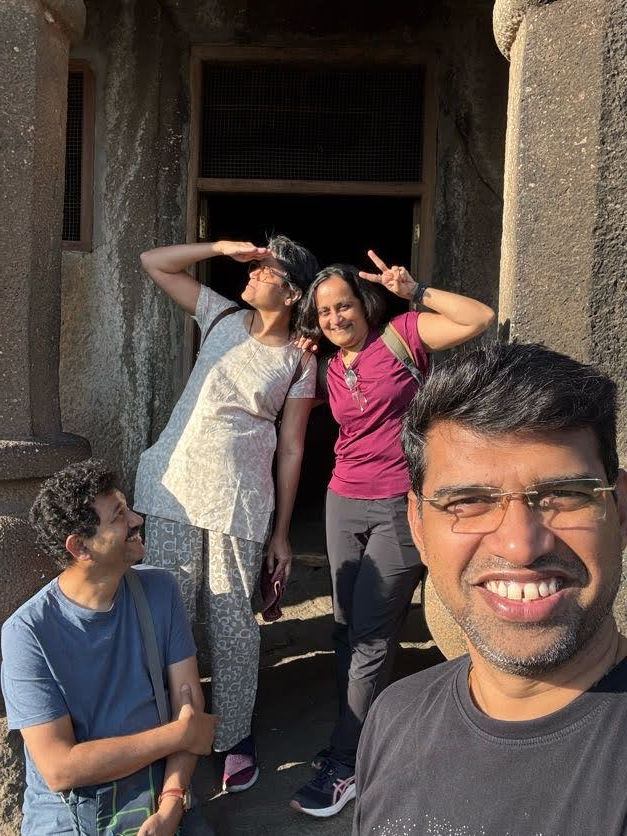
Today, we were determined to start early. Punctuality runs in the family, and after the late start yesterday, we felt a bit off, like we’d committed some blunder 😄. We also got the feeling the hotel staff were in their own 'relaxed time zone,' (susegad) so we figured it was safer (and faster) to grab breakfast on the way rather than wait for them to catch up with us. Honestly, we were craving misal pav at the famous ‘Karmarkar Misal’ in Mahad. It lived up to our expectations. Misal was yummy! The next place was a highlight of our trip; the Gandharpale caves. A quick reading had told me that these were a group of some 28 Buddhist rock-cut caves from the 3rd or 4th century CE. It was a 15 minute climb to the first layer of the caves. We found some rock inscriptions and stupas. We spent some peaceful moments there enjoying the beautiful landscape beneath and watching the Mumbai Goa highway curve a 90-degree angle. Coming from the city, I couldn’t help but compare this height to the 18-story view from our apartment; crazy isn’t it.
From the caves we travelled to the Nandavi village to find more veergals and an ancient Shiv temple. The next on our list was the Mankar wada in Kharivli village near Mangaon. This wada was once a residence for Sardar Khandoji Mankar. He worked for Kanhoji Angre, a prominent Maratha naval commander in the 17th century. The wada served as a glimpse into a traditional Marathi household, still carrying the proud mantle of its rich history. Afterward, we had lunch at The Open Umbrella and then returned to our resort, feeling content from the day's exploration and looking forward to some quiet time appreciating the beautiful view at the resort.
Day 4: Jan 4 2025
Today, Rajadhyax’s decided to take it slow - slightly out of character 😉😄for us. After a lip smacking breakfast of puri bhaji we left for a place called Umbardi which houses an ancient Shankar Mahadev Temple, a beautiful example of Hemadpanti architecture. Crafted entirely from basalt using dry masonry, the structure relies on tenon-and-mortise joints—no mortar involved! The peculiar style creates a noteworthy effect of alternating light and shadow within the temple kalas. A quick history tidbit - Hemadpanti Sculpture is an architectural style, named after its founder, the prime minister Hemadpant (1259-1274 CE) of the court of Seuna Yadavas of Devagiri. Hemadpant was a scholar, diplomat, and minister in the court of the Yadava dynasty of Devagiri, serving under King Ramachandra and his successor, Singhana II, during the 13th century. Another interesting thing about this place was the abundantly found memorial stones: veergals, sati gals and gadhe gal. While I didn’t count them all, a blog I came across mentions there are around 53 such stones, including a rare gadhegal stone. Walking through this ancient site felt like stepping back in time, almost 700 years ago.
We had pretty much covered everything we had planned. Today was the last day of our trip. Carrying the memories from our journey, we were heading back to our resort when we spotted something. There was a signboard about a place called “Ragat baav well” around the village Kadape. It was just 100 meters away. Curious to know more, we decided to walk it. We walked through the dusty farm path and discovered a key shaped well. Legend has it that Abaji Sondeo, one of the Maratha sardars, used this well to stash loot from Kalyan on his way to Raigad. But the story doesn’t end there. During the Nizamshahi era, a fierce battle was fought in this area, resulting in such a bloodbath that the well earned its ominous name—Ragat Baav. This unplanned discovery was the perfect way to wrap up our trip, filled with fun, mystery, history, adventure, and togetherness.
New year, new resolutions—right? Well, I’ve got one too! Last year, I promised myself I’d start writing regularly, and to my great delight, I stuck with it. This year, I’m taking it a step further. While I’ll continue writing about AI, neuroscience, and those deep soul-searching thoughts, I’ve decided to add something new: my travels.
We will surely be going on many more such trips this year, and I’ve promised myself to capture these happy moments—not just in words, but with pictures to go along. It’s a simple way to turn these memories into something special. After all, aren't these happy moments the real treasure? Here’s to more writing and exploring this year!
To know more about the veergals and the Shiva temple, I found an excellent blog here: https://kevinstandagephotography.wordpress.com/2024/01/12/where-stones-speak-the-memorial-stones-at-umbardi-shiva-temple/#comments


Comments