Every HVAC Project Is Different. So Why Do We Keep Reinventing the Wheel?

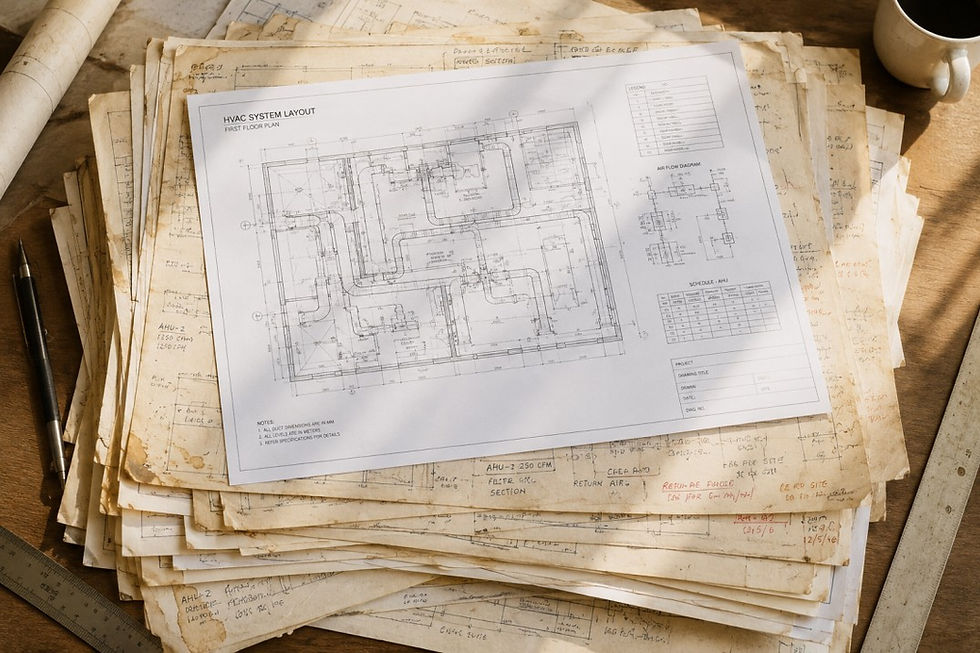
Most HVAC companies would agree with one statement: no two projects are ever exactly alike.
A hospital project has very different requirements from a hotel. A pharmaceutical facility demands stringent environmental controls, while a data centre prioritizes uptime and precision cooling. Even within the same industry, customer preferences, building layouts, climate conditions, energy efficiency targets, and regulatory requirements can vary significantly.
This makes HVAC businesses fundamentally different from mass manufacturing industries. Many operate in an Engineer-to-Order (ETO) or Configure-to-Order (CTO) environment, where each customer order requires a certain degree of engineering, customization, and problem-solving.
Yet there is an interesting paradox.
While every HVAC project is unique, no project is entirely new.
An organization that has been executing projects for ten or twenty years has already accumulated an enormous repository of knowledge. Similar cooling capacities would have been designed before. Comparable clean room projects would have been executed. Similar customer queries would have been answered. Site challenges encountered in one project would likely reappear in another.
And yet, engineers often find themselves starting from scratch.
Where Does All This Knowledge Reside?
Over the lifecycle of an HVAC project, organizations generate a vast amount of information.
During the sales and proposal stage, teams create technical proposals, compliance matrices, cost estimates, and bid clarifications. Engineering teams produce heat load calculations, equipment sizing sheets, HVAC schematics, control philosophies, layout drawings, shop drawings, and material specifications. Execution teams generate installation reports, RFIs, change requests, inspection reports, and site issue logs.
Finally, commissioning and service teams create balancing reports, commissioning records, troubleshooting notes, service reports, and lessons learned.
Over the years, this information gets distributed across multiple locations:
Shared drives
Email archives
Personal folders
ERP systems
Document management systems
Laptops of individual engineers
Much of the most valuable knowledge often resides only in the minds of experienced employees.
As a result, when a new enquiry arrives, engineers spend considerable time searching for information that the organization already possesses.
The Cost of Reinventing the Wheel
Consider a common scenario.
A customer issues an RFQ for a pharmaceutical manufacturing facility.
The proposal team immediately starts asking questions:
Have we executed a similar pharma project before?
What type of AHU configuration was proposed?
Which compliance requirements were applicable?
What assumptions did we make during estimation?
Did we face any challenges during commissioning?
Finding answers is rarely straightforward.
Engineers search through folders, call senior colleagues, review old emails, and examine previous proposals. In many cases, recreating the work appears faster than locating existing information.
The same pattern repeats during project execution.
A site team may encounter space constraints, duct routing conflicts, control integration issues, or pressure balancing problems. Frequently, similar issues would have been encountered and resolved in earlier projects. However, unless the right people remember the solution, the team often ends up solving the problem all over again.
T
his creates several business challenges:
Longer proposal turnaround times
Increased engineering effort
Duplicate work across teams
High dependence on senior experts
Inconsistent quality across projects
Slower onboarding of new engineers
Loss of valuable knowledge when employees leave
For growing HVAC organizations, these challenges become even more pronounced as teams expand across multiple locations and projects increase in complexity.
How Can AI Help?
Artificial Intelligence offers an opportunity to transform years of accumulated organizational experience into a readily accessible asset.
Imagine an engineer receiving an enquiry for a new clean room project.
Instead of manually searching through hundreds of folders, the engineer could simply ask:
"Show me similar pharmaceutical projects executed in the last five years."
Within seconds, an AI-powered knowledge assistant could retrieve:
Similar past projects
Relevant proposals and compliance documents
Equipment configurations used earlier
Design calculations and drawings
Commissioning reports
Site issue logs
Lessons learned from previous implementations
Similarly, during execution, a site engineer facing an airflow balancing problem could ask:
"Have we encountered similar balancing issues before?"
The system could instantly surface previous incidents, corrective actions, and relevant technical documents.
The objective is not to replace engineers. Engineering judgment, customer understanding, and innovation will always remain critical. AI simply enables engineers to leverage the collective experience of the entire organization rather than relying solely on personal memory or informal networks.
From Individual Knowledge to Organizational Knowledge
In many HVAC companies, competitive advantage is built not only on equipment, engineering expertise, or execution capability, but also on the knowledge accumulated across hundreds of projects.
The challenge is rarely a lack of experience.
The real challenge is ensuring that this experience is available to every engineer, whenever it is needed.
As HVAC projects continue to become more complex, organizations that can systematically capture, reuse, and scale their knowledge may find themselves responding faster, executing better, and delivering more consistently than their competitors.
After all, every HVAC project may be different. But there is little value in solving the same problem twice.


Comments